AI in Banking – Key Insights for Technology Leaders from the 180 Minutes
Artificial Intelligence is no longer experimental in banking. It is operational, transformative, and accelerating. For technology leaders, this shift brings both opportunity and responsibility: embedding AI safely, scaling it for real business value, and ensuring governance at every step.
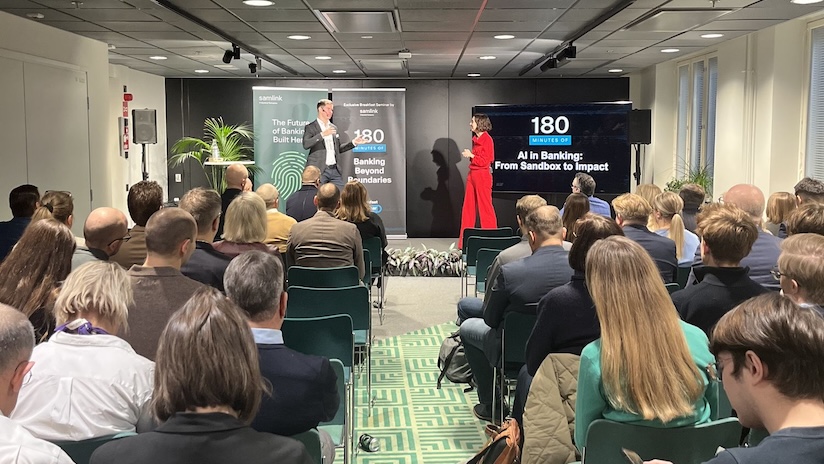
On December 3, 2025, Samlink hosted 180 Minutes of AI in Banking: From Sandbox to Impact in Helsinki. The event explored how AI is reshaping financial services through keynotes, demos, and a panel discussion. The message was clear: success depends on collaboration, strong data foundations, and empowering people, not just technology.
Why this matters?
Sara Ramakers, CEO of Samlink, set the tone: “AI is not a question of ‘when’, it’s already here.” She shared examples of using AI for language translation and market insights, showing how AI is already part of everyday processes and will increasingly drive banking innovation. The challenge is not if but how to integrate AI without compromising compliance, security, or trust.
AI as Your Creative Partner: Faster Ideas, Better Collaboration
Jukka Palosaari, Head of CRM & AI Development at Savings Bank, explained how AI can boost creativity and collaboration. By reframing questions, generating ideas, and speeding up prototyping, AI can reduce processes from days to minutes.
“AI can hugely complement your creativity,” said Jukka, while emphasizing that humans must validate and refine outputs to avoid over-reliance.
Key insight: Creativity is no longer limited to specialists. Success requires critical thinking, good prompting skills, and governance to ensure AI supports people rather than replaces them.
From Automation to Agentic AI: What It Means for Banking
Philippe Santraine, Head of AI Product Management at Samlink, described the shift from traditional automation to agentic AI, meaning autonomous agents that act and collaborate. These agents can manage complex workflows, such as mortgage processing, reducing manual work and errors.
“Professionals who use AI will replace those who don’t,” Philippe emphasized.
Key insight: Compliance and governance remain central. AI literacy and teamwork across business and technology are essential.
Scaling AI for Real Business Value: Lessons from Global Projects
On the last keynote, Žiga Kljun, Associate Director of Artificial Intelligence at Kyndryl, shared lessons from global projects. He introduced Kyndryl’s modular Agentic AI Framework, which combines pre-built agents, orchestration tools, and policy-as-code for safe adoption.
His demo showed how a UK bank cut corporate onboarding from 14–30 days to just 30 minutes, while keeping humans in the loop for final decisions.
“The biggest challenge isn’t technology, it’s embedding AI safely and effectively,” Žiga said.
Key insight: Success depends on data quality, governance, and employee enablement.
AI Adoption in Banking: Insights from Industry Leaders
The closing panel brought together all keynote speakers with Sara Ramakers to discuss critical questions about AI adoption in banking. The focus was on separating hype from reality and finding practical steps for sustainable transformation.
The panel agreed that AI is no longer hype. It delivers real value and is reshaping banking.
“AI is already here, and it’s changing how decisions are made at every level,” Philippe noted.
Rather than replacing jobs, AI will redefine roles. Professionals who adopt AI tools will outperform those who do not. Leadership must set governance, drive upskilling, and ensure responsible use.
Critical thinking and prompt engineering were highlighted as essential skills, along with collaboration between business and technology teams. Success will depend on breaking silos and partnering with trusted providers, while solving technical challenges such as legacy systems and fragmented data.
“Start with high-impact use cases, improve data quality, and embed governance at every stage,” Žiga emphasized.
Collaboration and Continuous Learning as Success Factors
The event showcased a range of perspectives, from leadership to hands-on technical demos. All speakers agreed on the importance of collaboration, both internally and with partners, to overcome challenges like data silos, legacy systems, and skills gaps.
AI in banking is here to stay. The winners will combine speed with governance, creativity with critical thinking, and technology with human insight.
“I encourage you to see yourselves as active drivers of change and to leverage available resources, such as workshops and AI labs, to accelerate your own AI journeys,” Sara concluded, also sharing examples of how Samlink and Kyndryl have already delivered successful AI-driven solutions for Nordic banks.
Watch the highlights and keynote videos of this and the previous events on YouTube.